
Learn how to Stop your puppy’s biting fast with proven, positive puppy training techniques. Training a puppy while it is young is the foundation for life with your gentle companion. Puppies are adorable and playful and come with needle-sharp teeth. Here are valuable tips for training “mouthy” puppies.
Teaching your large breed puppy to stop biting will help save your household items, your shoes, and your fingers. Training will teach your puppy valuable social behavior skills.
These training skills will help you divert and stop your puppies from biting and nipping without force or fear-based techniques. Early bite training will help your puppy grow into a well-behaved adult by stopping innocent, playful biting before it becomes a malicious habit.
Let’s get started teaching you how to gently discipline your mouthy pup at any age.
How to Stop Your Puppy Biting Fast Summary Table
| Situation | What to Do | Why It Works |
|---|---|---|
| Normal play biting | Stop movement, remove attention, resume calmly | Puppies bite for interaction. Removing the reward teaches control. |
| Overexcited biting | End play and enforce a short calm break | Overarousal reduces impulse control. Calm resets the nervous system. |
| Teething discomfort | Provide appropriate chew items | Redirects biting to acceptable outlets and relieves pain. |
| Hands used as toys | Stop using hands in play immediately | Prevents reinforcing biting as a game. |
| Puppy biting clothes or ankles | Freeze movement and redirect to a toy | Movement triggers chase and bite behavior. |
| Biting during petting | Pause interaction and give space | Puppies bite when overstimulated or tired. |
| Biting increases at night | Enforce naps and reduce stimulation | Most evening biting is exhaustion, not behavior issues. |
| Growling with biting | End interaction calmly, no punishment | Growling is communication, not defiance. |
| Biting not improving | Check sleep, routine, and consistency | Most issues persist due to fatigue or mixed signals. |
| What not to do | No yelling, no hitting, no dominance tactics | These increase stress and make biting worse. |
Puppy biting stops fastest when you manage arousal, remove reinforcement, and stay consistent.
How to Quickly Stop Your Puppy From Biting
To quickly reduce mouthy puppy biting, you need two things working together: an immediate, consistent response in the moment, and a clear plan for what your puppy should do instead.
What to do the moment your puppy bites
When your puppy bites your hands, feet, clothing, or any body part, respond right away.
- Interrupt immediately
Use a simple marker like “Ouch!” or “Stop!” in a calm, firm voice. Your goal is not to scare your puppy. Your goal is to clearly communicate that biting ends the interaction. - Remove the target
Calmly remove your hand, foot, or body part from the puppy’s mouth. Do not jerk away dramatically. Do not flail. Keep your movement controlled and boring. - Redirect to an appropriate chew
Give your puppy a favorite chew toy. Repeat your cue, such as “Stop” or “Leave it,” and guide the puppy to the toy. - End the interaction if the puppy continues
If your puppy ignores the toy and continues to bite, calmly stand up and walk away. This matters because attention is often the reward. Removing your attention teaches that biting makes fun stop.
This pattern needs repetition. The speed of improvement comes from consistency.
What not to do while trying to stop biting quickly
A lot of puppy biting becomes a long-term problem because owners accidentally teach the puppy that biting is part of play.
- Do not play wrestle with your puppy and allow them to bite or mouth your hands for fun, especially with large breed puppies.
- Do not pin your puppy down with your hand while play growling or roughhousing.
- Do not turn your hands into toys, even if it seems harmless while your puppy is small.
Instead, keep play structured and redirect to toys. If your puppy escalates into biting, end play and remove attention. That is the clearest consequence you can give without creating fear.
Use attention removal the right way
If your puppy insists on biting during play, the fastest solution is often the simplest.
- Remove your attention immediately.
- Walk away.
- Do not reward the behavior with continued play, laughter, or wrestling.
This is the same feedback an adult dog gives a puppy who plays too rough. They disengage. That is how puppies learn bite control socially.
This is also a great time to practice the cue “Leave it.” Many large breed owners find “Leave it” essential for creating a calm, gentle companion. Alongside “Leave it,” you can begin building impulse control, because self control is what replaces mouthiness long term.
What to avoid completely
- Do not yell at your puppy.
- Do not use physical force.
- Do not do anything that makes your puppy fear your hand or fear interacting with you.
Never strike your puppy or correct in a way that creates fear. Fear based handling can create defensive, fear-driven biting as the dog matures. Your goal is to teach manners and self control, not to teach your puppy that people are unpredictable.
Always use positive, reward-based training to teach acceptable behavior and build trust in your relationship.
Correcting Your Large Breed Puppy the Right Way
Let’s talk about corrections, because this topic gets controversial in dog training.
Many owners worry that any correction will harm the puppy. Others assume correction means punishment. Neither extreme helps your puppy. What matters is understanding the difference between a calm, mild correction and a fear-based punishment.
A mild correction is simply a clear, immediate boundary. It is a short communication that says, “That behavior ends the interaction.” It does not require intimidation, force, or fear.
Why this matters more for large breed puppies
Some people think it is fun to play wrestle and encourage a cute puppy to attack feet, hands, or clothing. It feels harmless because the puppy is small. But let’s think long-term.
Your large breed puppy may grow into a 90 to 150 pound adult. That dog will be powerful, with an adult bite force that can cause real injury even without true aggression. Teaching bite manners early prevents accidents later and reduces the chance of problem behaviors becoming ingrained.
This is why mild, appropriate reprimands and consistent boundaries matter. You are not trying to “dominate” the puppy. You are teaching the puppy how to live safely in a human household.
Discipline is not punishment
Some people hear the word discipline and think it means harsh punishment. It does not.
Positive corrective techniques teach life skills. They create clarity. They do not involve physical force or fear-based tactics. Your puppy can learn what is acceptable without being frightened or harmed.
What you will learn in this post
This guide is designed to give you practical, proven ways to stop mouthy behavior and build a gentle, safe adult dog.
You will learn:
- The reasons puppies bite
- The most effective way to correct puppy biting in the moment
- Actions to avoid so you do not accidentally encourage biting
- Techniques that help large breed puppies grow into gentle, stable companions
You will also learn how to teach your puppy not to bite people and how to understand what is and is not appropriate to chew on, so your puppy develops clear habits that last.

Why Does My Puppy Bite Everything?
Most puppy biting is normal behavior. Puppies use their mouths to explore their environment and interact with the world around them. Chewing and biting are part of how puppies learn, play, and develop physically and socially.
However, not all biting comes from the same place. Some puppies bite due to fear, frustration, or feelings of abandonment. This type of biting is different from normal puppy mouthing and can be an early warning sign of future aggression if not addressed correctly.
Common reasons puppies nip and bite
The most common causes of puppy biting include:
- Teething. Often called “the dreaded puppy phase”
- Lack of physical exercise or mental stimulation
- Boredom and tiredness
- Social skills development
- Practicing natural instincts
All puppies chew and bite during puppyhood. Teething discomfort, natural prey drive, and social development all contribute to a puppy’s desire to mouth and chew objects, people, and their surroundings.
You can take positive steps to redirect your puppy’s need to chew by offering plenty of safe, appropriate chew toys. While normal puppy mouthing is expected, aggressive biting should never be tolerated in your home or in your interactions with your puppy.
Below is a more detailed look at the primary reasons puppies are mouthy and why they enjoy chewing and biting, especially during play.
Why Puppies Bite Everything: Quick Explanation Table
| Cause | What It Looks Like | Typical Age | What Helps Most |
|---|---|---|---|
| Teething | Chewing furniture, hands, clothing | 3–6 months | Frozen chew toys, appropriate chews |
| Overstimulation | Wild biting during play, zoomies | Any puppy | Enforced naps, calmer play |
| Boredom | Destructive chewing, attention biting | Any puppy | Mental enrichment, training games |
| Social development | Mouthy play, rough interaction | 8–16 weeks | Bite inhibition training |
| Instinctual behavior | Nipping, chasing movement | Breed dependent | Redirection and boundaries |
| Fear or frustration | Hard bites, growling | Situational | Reduce stress, slow interactions |
Early Puppy Development and Social Bite Inhibition
From birth, puppies begin learning social behavior from their mother and littermates. Play is how puppies communicate and develop essential skills. During play, puppies bark, growl, mouth wrestle, and bite one another.
What is bite inhibition?
Bite inhibition is a critical part of early puppy development. During this phase, your puppy learns how much pressure is acceptable when using their mouth. This teaches a “soft mouth” so littermates are not injured during play.
Puppies quickly learn that biting too hard has consequences. When a puppy bites too forcefully, littermates stop playing and walk away. Older dogs may ignore or disengage from puppies that bite rudely. This teaches an important lesson that rough behavior ends interaction.
These early lessons are essential for living safely with people and other dogs later in life.
Eight Week Old Puppies and Bite Inhibition
A puppy’s mother plays a major role in teaching early bite inhibition. She corrects puppies when they play too roughly or bite too hard. This natural correction teaches boundaries and appropriate behavior.
If a puppy is removed from its mother too early, these lessons may not be fully learned.
Leaving a puppy with its mother for a minimum of eight weeks is critical for proper social development. Studies show that removing puppies before eight weeks of age can negatively affect behavior later in life.
For large breed puppies, it is often recommended that they remain with their mother for up to twelve weeks. The additional time allows puppies to develop stronger social skills and better impulse control.
Be cautious of breeders who encourage early pickup. Early separation can have lasting behavioral consequences.
Once your large breed puppy comes home, they should continue learning bite inhibition from you through calm, consistent interaction.
Puppy Teething Phases
All puppies go through teething. This process can significantly increase chewing and biting behavior.
Early tooth development
- Puppies begin developing baby teeth around two weeks of age
- By six to seven weeks of age, all baby teeth are usually present
- By the time you bring your puppy home at eight to ten weeks, they should have a full set of baby teeth
As adult teeth begin to develop, the gums can become irritated and sore. This discomfort often leads puppies to chew furniture, household objects, and anything they can get into their mouths in an attempt to relieve pain.
Three to Four Month Old Puppy Biting and Teething
Around three to four months of age, a puppy’s baby teeth begin to loosen and fall out as adult teeth push through. This stage often marks the height of chewing behavior.
You may find small teeth around your home, though many puppies swallow them. This is normal and does not cause harm.
Chewing during this phase is your puppy’s natural way of soothing teething discomfort. Providing appropriate outlets is essential.
Frozen chew toys, such as a frozen Kong filled with safe treats, can help reduce inflammation and redirect chewing away from household items.
Always keep several frozen puppy-safe toys available during teething. Durable chew objects help protect your home and provide relief for your puppy.
Most puppies begin to grow out of intense puppy biting around five months of age, although chewing may continue in a more controlled form.
Puppy Teething Phases Timeline Table
| Puppy Age | What Is Happening | Normal Behavior | What You Should Do |
|---|---|---|---|
| 2 weeks | Baby teeth begin forming | Minimal chewing | No action needed |
| 6–7 weeks | All baby teeth present | Mouthing increases | Provide soft chews |
| 3–4 months | Baby teeth loosen and fall out | Intense chewing | Frozen toys, supervision |
| 3–8 months | Adult teeth erupt | Continued chewing | Rotate chews, redirect |
| 6–8 months | Adult teeth complete | Biting decreases | Maintain boundaries |
Recap of Puppy Teething Phases
- 2 weeks old: Baby teeth begin developing
- 6 to 7 weeks old: All 28 baby teeth have erupted
- 3 to 4 months old: Baby teeth loosen and fall out naturally
- 3 to 8 months old: Teething discomfort is common and chew toys should be provided
- 6 to 8 months old: All 42 adult teeth are fully present
Boredom and Lack of Mental Stimulation
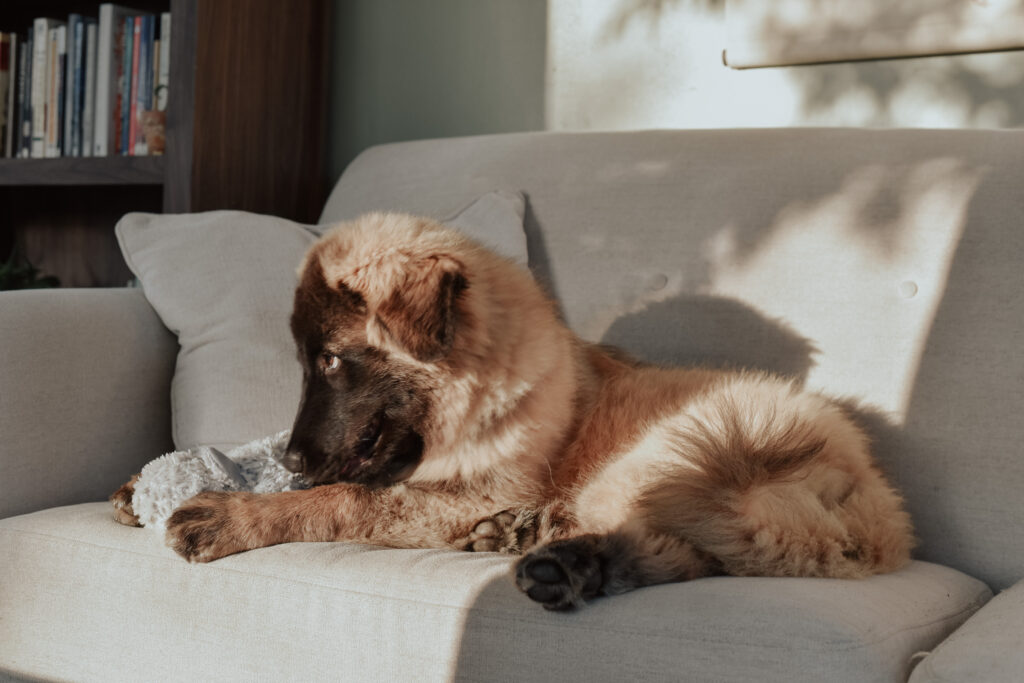
Most large breed puppies, especially the Estrela Mountain Dog, are highly intelligent. Intelligent puppies often have high energy levels and require both mental and physical stimulation to stay balanced.
Puppies need regular exercise, structured games, and environments that allow them to develop problem-solving skills. These skills are crucial to healthy development, particularly for puppies that may grow into livestock guardian roles, where independent thinking is required.
When a puppy lacks proper mental stimulation, they will find ways to occupy their mind on their own. This often results in unwanted behaviors such as chewing, biting, or getting into trouble. Mental stimulation tires your puppy in a productive way, helping reduce excess energy and frustration that can lead to mouthy behavior.
Your Dog’s Natural Instincts
Most dog breeds were originally developed to perform specific jobs. Because of this, puppies naturally display instincts tied to their breed’s historical purpose.
For example:
- Herding breeds were developed to move and control livestock
- Livestock guardian breeds were developed to calmly guard livestock with very low prey or chase drive
These instincts are not learned behaviors. They are genetic.
How instincts affect puppy biting
Herding puppies often bite or nip at ankles due to their natural herding instincts and strong prey drive. This behavior is instinctive, not aggressive. However, if it is not gently discouraged, herding puppies can develop a reputation as “ankle biters.”
Herding puppies must be taught early that nipping people is not acceptable, even though the behavior is natural to them.
Most giant breed puppies, including livestock guardian breeds, have a lower prey drive and are less likely to play attack their owners compared to smaller or herding breeds. However, livestock guardian puppies must still be discouraged immediately if they begin play biting, chasing other pets, or nipping family members.
Instinct explains behavior, but it does not excuse it. Puppies still need clear guidance.
How to Stop a Puppy from Biting and Nipping
Puppies need to learn from the beginning that biting hurts and does not get them what they want. This is taught through consistent communication, not force.
Start by:
- Using clear verbal cues
- Using calm body language
- Showing your puppy the behavior you want instead
If your puppy continues to bite aggressively despite redirection, a short, calm time out can be used to allow the puppy to reset.
Always use positive training techniques. Never punish your puppy harshly.
You can practice these techniques by following clear, consistent steps that teach your puppy how to interact appropriately without using their mouth.
How to Stop Puppy Biting Fast: Action Table
| Situation | What to Do Immediately | Why It Works |
|---|---|---|
| Puppy bites hands | Say “Stop,” remove hands | Ends reinforcement |
| Puppy bites during play | Stand up and walk away | Attention removal |
| Puppy bites clothes | Freeze movement, redirect | Reduces chase drive |
| Overexcited biting | End play, enforce calm break | Lowers arousal |
| Evening biting | Nap or quiet crate time | Prevents overtired behavior |
| Persistent biting | Review sleep and routine | Fixes root cause |
Teaching Bite Inhibition
One of the most important skills your puppy must learn is bite inhibition.
Your puppy needs to understand how to control the force of their bite while they are young. There may be situations in adulthood where your dog is scared, in pain, or uncomfortable and briefly puts their mouth on a person. Bite inhibition ensures that pressure is controlled and injury is avoided.
Puppies that learn bite inhibition through early social interaction with their mother and littermates already have a foundation. During play, they learn that biting too hard ends interaction.
When reinforced correctly at home, bite inhibition allows puppies to grow into adults that understand how to use their mouth gently, even in stressful situations. This protects family members and helps prevent serious accidents.
Practicing Bite Control Through Play
While teaching your puppy not to bite, you can still play and engage with them in appropriate ways. Structured games allow puppies to practice impulse control, self-regulation, and gentle interaction without encouraging mouthy behavior.
These games support learning while reinforcing that human skin and clothing are never acceptable chew targets.
Puppy Bite Inhibition Training
Bite inhibition training teaches your puppy that human skin, clothing, and body parts are not acceptable chew targets and that rough play ends interaction.
What to do the moment your puppy bites
When your puppy bites you during play:
- Make an “ouch” or “ow” sound to communicate that the bite hurts
- If a high-pitched sound excites your puppy and causes harder biting, skip the sound and calmly disengage without fuss
- Gently remove your leg, hand, or any body part the puppy is biting
- If the puppy refuses to release what they are biting, such as a pant leg or finger, gently tap their nose to interrupt the grip
- Stop all play and communication for 10 to 15 seconds
After the brief pause, you may resume interaction.
If the puppy bites again, stop immediately. Do not reward biting with continued play or attention. This mirrors how adult dogs teach puppies by disengaging when play becomes too rough.
Teaching Your Puppy That Biting Ends Playtime
Your puppy needs to clearly understand that biting makes play stop.
If your puppy continues to bite aggressively after play has resumed, show them that playtime is over. Ending interaction is the consequence.
A hard bite that damages the skin means the game ends immediately.
Consistency matters. If play sometimes continues after biting, the puppy will keep testing.
How to Stop Aggressive Biting During Play
When your puppy hurts you during play, respond the way another dog would.
- Ignore the puppy and walk away
- Calmly move to a place where the puppy cannot follow you, such as a room where you can close the door
If your feet are on the floor, pick them up.
If your puppy has access to your hands, remove that access.
Do not allow the puppy to continue reaching you and biting. Preventing access is part of teaching boundaries.
Why Walking Away Works
Distancing yourself and removing your attention during aggressive biting helps calm the puppy by eliminating the reward.
Attention, movement, and interaction often fuel rough play. By withdrawing all three, you show your puppy that aggressive biting does not lead to engagement.
This approach stops puppy biting effectively without using negative force and reinforces that calm behavior is the only way to keep play going.

Distract your Puppy with appropriate chew items
Provide appropriate toys and items for your puppy to chew before he destroys your favorite pair of flip-flops.
Keep durable chew toys available, and distract chewing behavior in a positive way, by offering toys whenever your puppy nips your feet or fingers.
What toys do Puppies like to bite and chew?
Large breed puppies have powerful jaws and need durable toys that are not easily dissembled or splinter into choking hazards. Dog chew toys should be able to withstand a significant amount of wear and tear. An empty water bottle, large carrots, or a wet, frozen, knotted hand towel can provide hours of entertainment for your puppy.
My puppies loved rolling toys that are built for heavy chewers, like this Monster Ultra Durable Chew toy.
Livestock guardian dogs should never be allowed to chew on items that squeak or resemble baby animals. Never use a plushy chew toy, such as a stuffed animal or a squeaky chew toy for Livestock guardian puppies. Livestock guardian puppies can be given teddy bears to snuggle, carry or play with, but they should be supervised to prevent them from destructive behavior.
Stop Your Puppy Biting With a Time Out
Sometimes a short time out is necessary for hard nipping and aggressive biting. Time outs are appropriate when your puppy continues to bite despite redirection and disengagement.
We have all experienced moments where a puppy keeps biting no matter what we try. In these situations, a brief, calm break helps reset the puppy’s nervous system.
How to use a time out correctly
Gently place your puppy in a safe, designated time out space. This can be:
- A crate
- A quiet room
- A pet safe area blocked by a partition gate
The goal is not isolation or punishment. The goal is to give your puppy space to calm down and stop biting.
Place your puppy in the crate or time out area and give them their favorite chew toy so they can decompress. Time out should always be a chance for your puppy to self soothe.
After your puppy calms down, let them out calmly. Make sure your puppy does not begin to associate the crate with punishment. The crate should remain a safe, positive space.
How to Correct Aggressive Biting and Mouthing With Time Out
When using a time out for biting:
- Gently take your puppy to the designated time out area
- Do not scold, yell, or show frustration
- Do not provide excessive toys or stimulation during time out
If your puppy cries excessively, you may offer a favorite chew toy depending on their age. The purpose is calming, not distraction.
Keep your puppy in time out for up to five minutes. Puppies that are five to six months or older may need slightly longer. Be flexible and base the length of time on how long it takes your puppy to self calm.
Only let your puppy out once they are calm and no longer crying or whining.
Never treat time out as abandonment or harsh punishment. Using time out incorrectly can damage the trust bond between you and your puppy.
Make Sure Your Puppy Is Not Hungry or Overtired
Some puppies bite excessively because they are hungry, overstimulated, or overtired. Routine plays a major role in preventing these situations.
Just like human babies, puppies need regular sleep. A puppy without adequate rest becomes difficult to manage and struggles to focus on cues and boundaries.
Puppies need a quiet place to rest, away from the stimulation of daily household activity. You would not expect a human baby to sleep in a loud living room. Your puppy cannot either.
Setting a Routine for Your Puppy
Routine helps your puppy feel secure and predictable, which reduces biting behavior.
Puppies need:
- Regular small meals
- Access to fresh water
- Consistent potty breaks
Sometimes biting is simply a sign that your puppy is hungry, needs to potty, or is overstimulated.
Puppies sleep up to 20 hours a day. An overstimulated puppy is often a cranky puppy. When your puppy becomes mouthy and wild, rest is often the solution.
Place your puppy in their crate with:
- A comfortable bed or blanket
- A blanket draped over the crate to reduce stimulation
- A few familiar toys
After a nap, puppies are typically calmer, more focused, and easier to redirect.
Creating a Calm Sleep Environment
You can support your puppy’s ability to rest by creating a soothing environment.
Helpful options include:
- A fan positioned to blow away from the puppy
- A sleep aid that simulates a mother’s heartbeat and warmth
- A white noise machine
These tools help overstimulated puppies settle and sleep more deeply.
Here are our favorite sleep aids for puppies of all ages.
Why Routine Matters for Biting
Routines are crucial for helping your puppy learn and grow into a smart, gentle adult dog. When puppies get enough sleep, mental stimulation, and structure, biting behaviors decrease naturally.
You can often stop puppy biting more easily when the puppy’s daily needs are met consistently.

How to Teach “Leave It” and “Drop It”
Teaching the “Leave It” and “Drop It” cues can feel overwhelming at first, but these skills are foundational for impulse control, safety, and trust. Early “Leave It” training helps your puppy learn self regulation, keeps them safe from dangerous items, and strengthens the bond between you and your puppy.
“Leave It” cues are especially critical for livestock guardian puppies and should be a regular part of early puppy education.
Puppies need to learn as early as possible that they cannot put toxic or dangerous items into their mouths. Teaching this skill early prevents many future problems.
How to Start Training the “Leave It” Cue
Begin working on “Leave It” during everyday situations when your puppy already has something in their mouth.
- If your puppy is biting your clothes or chewing something inappropriate, calmly offer a treat
- When your puppy drops the item, praise them and mark the behavior using a clicker or the word your puppy associates with “Good”
- After rewarding, offer an appropriate chew item so your puppy has something acceptable to engage with
If your puppy enjoys chewing household items, practice swapping instead of grabbing. For example, if your puppy likes chewing shoes, trade the shoe for a safe and suitable chew option.
Never allow livestock guardian puppies to chew soft, fuzzy items such as pillows or stuffed objects. LGD puppies must learn to be gentle with anything soft. This early rule helps prepare them for future exposure to baby animals or birds and prevents destructive habits later. Nobody wants to come home to feather pillows spread across the house.
How to Train Your Dog to Have a Gentle Mouth
Your puppy needs to learn that only gentle mouth behavior is rewarded.
Training your large breed puppy to have a soft mouth is straightforward when using positive training techniques. Teaching acceptable mouth pressure early helps prevent unnecessary force, damaged clothing, and accidental injury to people or animals.
This skill is especially important for large breed and livestock guardian puppies, where size and strength increase quickly.
Training Your Puppy to Have a Soft Mouth
Begin training during calm moments, not during high excitement.
- Hold your puppy’s favorite treat securely between your fingers
- Allow your puppy to taste the treat by licking it
- If your puppy tries to chew or bite your hand, slowly pull your hand away out of reach
After two to three seconds, offer the treat again.
- When your puppy gently licks your hand without biting, praise them verbally and give the treat
- If your puppy bites out of excitement, stop and try again later when they are calmer
Soft mouth training works best after your puppy has had exercise and has burned some energy. Calm puppies learn faster and show better impulse control.
Tips for Successful Mouth Training
Keep training sessions short, positive, and consistent.
- Train two to three times per day
- Keep sessions five minutes or less
- Focus on calm interaction and clear rewards
Your puppy should associate treats, mouth training, and learning with positive experiences. Short, frequent sessions build understanding without frustration and help your puppy develop lasting self control.

Start Your Puppy in Obedience Classes
Puppy obedience classes do far more than teach basic commands. Effective classes cover dog behavior, the importance of puppy socialization, basic dog body language, and many other topics that support healthy development.
Puppy classes are helpful for all breeds, but they are especially important for giant breed puppies such as Estrela Mountain Dogs and other livestock guardian breeds. Guardian puppies that will live as family members need early exposure to other dogs. This helps prevent them from viewing unfamiliar dogs as threats later in life.
It is crucial for giant breed puppies to have appropriate socialization with other dogs before 16 weeks of age.
Making Puppy Classes Work for Your Schedule
If daily classes are not realistic, consider weekend classes or hiring a dog sitter so you can attend training sessions with your large breed puppy.
There are also many excellent virtual dog training programs available. Online courses often cover a wide range of puppy behavior topics, including biting and mouthing issues you may be working through. Online training can strengthen the bond between you and your puppy while giving you tools to handle common challenges.
Teaching Gentleness in Large Breed Puppies
Large breed puppies grow into powerful adults. Teaching gentleness during puppyhood is your responsibility as an owner.
Use positive mental stimulation and enrichment activities to engage your puppy and prevent boredom. Puppies are intelligent and creative. Without proper outlets, they will often invent activities you would rather they not practice.
Helpful ways to engage your puppy include:
- Enrichment activities designed for large breed dogs
- Toys and enrichment options suitable for livestock guardian puppies
- Easy ways to entertain and exercise your dog safely
Mental engagement helps prevent frustration and reduces mouthy or destructive behaviors.
Set Your Puppy Up for Success
Puppies should not have full access to the house until they are well trained.
When puppies are left unsupervised, they learn that they are on their own. They begin to make their own rules and discover they do not need to follow household guidelines. One of the most effective ways to prevent unwanted behavior is to stop the puppy from repeating it in the first place.
By controlling your puppy’s environment, you can prevent biting and other behaviors from becoming habits.
Examples of Managing Your Puppy’s Environment
- If your puppy chews shoes, remove shoes from areas the puppy can access
- If your puppy becomes overly excited during play, do not allow roughhousing that escalates into biting
- If your puppy runs around biting feet, attach a leash and secure it to a stable object until the puppy calms down
- If your puppy plays too roughly with children, move them to a crate or behind a dog safe gate so they can observe without chasing or nipping
Management is not punishment. It is guidance.
Supervise Your Puppy
Puppies need guidance and quality interactions. Shaping behavior early sets your puppy up for long term success.
Preventing your puppy from practicing unwanted behaviors helps them learn faster and makes success easier. Puppies do not come into your home knowing your preferences or your rules. Patience and structure are essential.
Give your puppy an environment where they can succeed instead of fail.
How Puppies Learn the Right Behavior
Dogs learn through a combination of obedience training and positive human interaction. Owners shape behavior by reinforcing what they want to see and gently making unwanted behaviors unrewarding.
Praise calm behavior.
Reward appropriate play.
Remove access to situations where biting occurs.
This approach builds understanding without fear and helps puppies grow into stable, well mannered adults.
Things Not to Do When Stopping Puppy Biting
Do not use punishment based methods
Never punish your puppy physically, mentally, or emotionally. Even mild punishment based training has been shown to increase stress levels in dogs. Elevated stress interferes with learning, reduces retention, and increases unwanted behaviors rather than resolving them.
Dogs trained with positive, reward based methods consistently show better learning outcomes, stronger retention of skills, and healthier long term behavior.
Do not use physical force of any kind
Never:
- Yank on your puppy’s collar
- Hit, smack, or shove your puppy
- Jerk your puppy roughly by the leash or body
- Force your puppy’s mouth open
- Grab or shake your puppy’s head or muzzle
Physical force damages trust and teaches fear, not self control.
Do not intimidate or frighten your puppy
Never chase your puppy when they are afraid.
Avoid yelling, threatening tones, or looming over your puppy as punishment.
Using fear or intimidation creates emotional stress and teaches your puppy that people are unpredictable. This undermines confidence and can increase defensive behavior over time.
Do not use outdated dominance or “alpha” techniques
Techniques such as:
- Shaking your puppy
- Forcing your puppy onto their back
- Growling at your puppy
- Taking food or objects away to “show dominance”
are outdated and not supported by behavioral science.
Research has shown that aversive and dominance based methods increase the risk of fear based and aggressive behaviors. These techniques do not teach bite control and often make problems worse.
Never grab your puppy’s mouth or shake them
Grabbing a puppy by the mouth or shaking them is especially harmful. Studies have shown that dogs subjected to mouth grabbing, shaking, or forced item removal show a significantly higher risk of aggression later in life.
Taking food or objects away forcefully can also create guarding behaviors rather than preventing them.
Advice like this is common online, but it is not safe and it is not effective.
Why punishment makes biting worse
Incorrect punishment breaks the trust bond between you and your puppy. When trust is damaged, puppies become more anxious, more reactive, and less able to regulate their behavior.
Biting improves fastest when puppies feel safe, understood, and guided with consistency, not when they are corrected through fear or force.
The correct foundation
Respect is the foundation of a healthy relationship with your puppy. When puppies are treated with calm leadership and clear boundaries, they learn self control without fear and grow into stable, confident companions.
Positive training is not permissive. It is effective. With patience and positive training, your adorable biting dinosaur will be the giant, gentle companion of your dreams.
Frequently Asked Questions: How to Stop Puppy Biting Fast
Is puppy biting normal or a behavior problem?
Puppy biting is normal. Puppies explore the world with their mouths and lack impulse control. Biting becomes a problem only when it is accidentally reinforced or not managed consistently.
When do puppies usually stop biting?
Most puppies begin to show real improvement between 4 and 6 months when teething slows and impulse control improves. Full mouth control often continues developing through adolescence. Fast improvement depends more on management than age alone.
Why does my puppy bite more at night?
Evening biting is almost always caused by exhaustion and overstimulation. Puppies that are overtired lose the ability to regulate their behavior. Enforced naps and calmer evenings usually reduce biting quickly.
Should I yelp when my puppy bites?
For many puppies, yelping increases excitement and makes biting worse. It can work for some soft mouthed puppies, but it is unreliable. Calmly stopping interaction is more consistent and effective.
Does ignoring my puppy really work?
Yes, when done correctly. Biting is often driven by attention and movement. Removing attention immediately teaches the puppy that biting ends interaction. Timing matters more than duration.
Is redirecting to toys enough to stop biting?
Redirecting helps, but it is only part of the solution. If the puppy is overtired or overstimulated, redirection alone will not work. Biting often stops fastest when redirection is paired with rest and calm boundaries.
Why does my puppy bite hands but not toys?
Hands move, react, and make noise. That makes them more exciting than toys. Puppies repeat behaviors that get the biggest response. Teaching calm interaction and removing hands from play solves this over time.
Is my puppy being aggressive?
In most cases, no. Puppy biting is about play, exploration, or overstimulation. Aggression in puppies is rare. Growling during play or frustration is communication, not dominance.
Should I punish my puppy for biting?
No. Punishment increases stress and often makes biting worse. Puppies learn bite control through calm consistency, not fear. Physical or verbal punishment damages trust and slows progress.
Does teething cause biting?
Yes, teething increases the urge to bite. Providing appropriate chew items reduces discomfort and helps redirect biting to acceptable outlets. Teething explains intensity, not persistence.
Why does my puppy bite more when excited?
Excitement reduces impulse control. Puppies bite when they cannot regulate their emotions yet. Managing excitement and enforcing breaks is more effective than correcting the bite itself.
Can training classes help with biting?
Yes. Puppy classes help with impulse control, frustration tolerance, and learning calm engagement. Classes support biting improvement but do not replace good management at home.
Should I use bitter sprays on my hands or clothes?
They can help in specific situations, but they do not teach self control. Sprays work best as a short term aid, not a long term solution.
Why does my puppy bite my clothes or ankles?
Movement triggers chase behavior. Puppies bite ankles and clothing because they move quickly. Freezing movement and redirecting calmly works better than reacting.
How fast should puppy biting improve?
With consistent management, many puppies show improvement within one to two weeks. Full resolution takes longer. If biting is not improving at all, sleep and routine are usually the issue.
When should I be concerned about puppy biting?
Be concerned if biting is paired with fear, avoidance, or extreme reactions. Most puppies simply need structure. If behavior feels intense or unpredictable, a professional evaluation can help.
What is the biggest mistake people make with puppy biting?
Trying to stop the bite without addressing overstimulation and fatigue. Most biting problems are routine problems, not training failures.
Does puppy biting mean my dog will bite as an adult?
No. Puppies that learn calm boundaries and impulse control almost always outgrow biting. Adult biting issues usually come from fear, stress, or poor early management, not normal puppy behavior.
What is the fastest way to reduce puppy biting?
Reduce arousal, enforce naps, stop reinforcing biting with attention, and stay consistent. Speed comes from prevention, not correction.
Learn more about Estrela Mountain Dogs Here
Related Estrela Mountain Dog Resources
If you’re still learning about the Estrela Mountain Dog and deciding whether this breed is right for you, these guides may help:
- Estrela Mountain Dog Puppies for Sale
Learn about current and upcoming litters, placement process, and availability. - What Serious Estrela Mountain Dog Owners Need to Know
A realistic look at lifestyle fit, experience level, and common challenges. - Estrela Mountain Dog Temperament Explained
What to expect from this breed’s independence, guarding instincts, and maturity timeline. - Is an Estrela Mountain Dog Right for You
Breeding purpose, behavior, and placement considerations. - How Much Do Estrela Mountain Dog Puppies Cost?
What affects pricing, why quality puppies cost more, and what expenses to plan for. - How to Find an Ethical Estrela Mountain Dog Breeder
A practical checklist to help you evaluate breeders and avoid common red flags. - How to Buy an Estrela Mountain Dog Puppy Buying the right puppy starts with understanding what you actually need the dog to do.
Sources & References
- American Veterinary Society of Animal Behavior
Position statements on normal puppy behavior, bite inhibition, and humane training practices
https://avsab.org/resources/position-statements/ - American Kennel Club
Puppy biting, teething timelines, and early training guidance
https://www.akc.org/expert-advice/training/stop-puppy-biting/ - International Association of Canine Professionals
Education on puppy development, impulse control, and behavior management
https://iacp.org - RSPCA
Puppy biting and mouthing behavior explained with welfare focused recommendations
https://www.rspca.org.uk/adviceandwelfare/pets/dogs/training/biting - Pet Professional Guild
Resources on humane training, puppy learning stages, and behavior prevention
https://petprofessionalguild.com - Veterinary Partner
Veterinary reviewed articles on teething, puppy behavior, and development stages
https://veterinarypartner.vin.com
Comments +